
Views: 0 Author: Site Editor Publish Time: 2026-04-01 Origin: Site
You can find die casting automotive parts in most cars today. This process shapes metals like aluminum into strong parts. These parts are precise and help your car work better. They also make your car last longer. Many car makers use automotive die casting. It makes cars lighter. Lighter cars use less fuel and perform better.
Die casting makes up 45% of the automotive casting market.
Here’s how die casting helps make cars lighter:
How Die Casting Helps | Why It Matters for Cars |
|---|---|
Uses light metal such as aluminum | Makes your car weigh less |
Allows complex designs in one step | Creates lighter, detailed parts |
Enables thinner walls than other methods | Needed for lightweight cars |
When you drive, you use lighter and stronger parts. These parts help your car work well every day.
Die casting makes car parts lighter. This helps cars use less fuel and work better. Using die casting lets people make complex shapes. This means car parts are exact and last a long time. Automotive die casting lowers the cost to make cars. This helps make cars cheaper for people to buy. Die casting uses materials that can be recycled. This helps the planet and makes less pollution. Die casting makes cars safer by making strong parts. These parts can handle stress and make cars better overall.
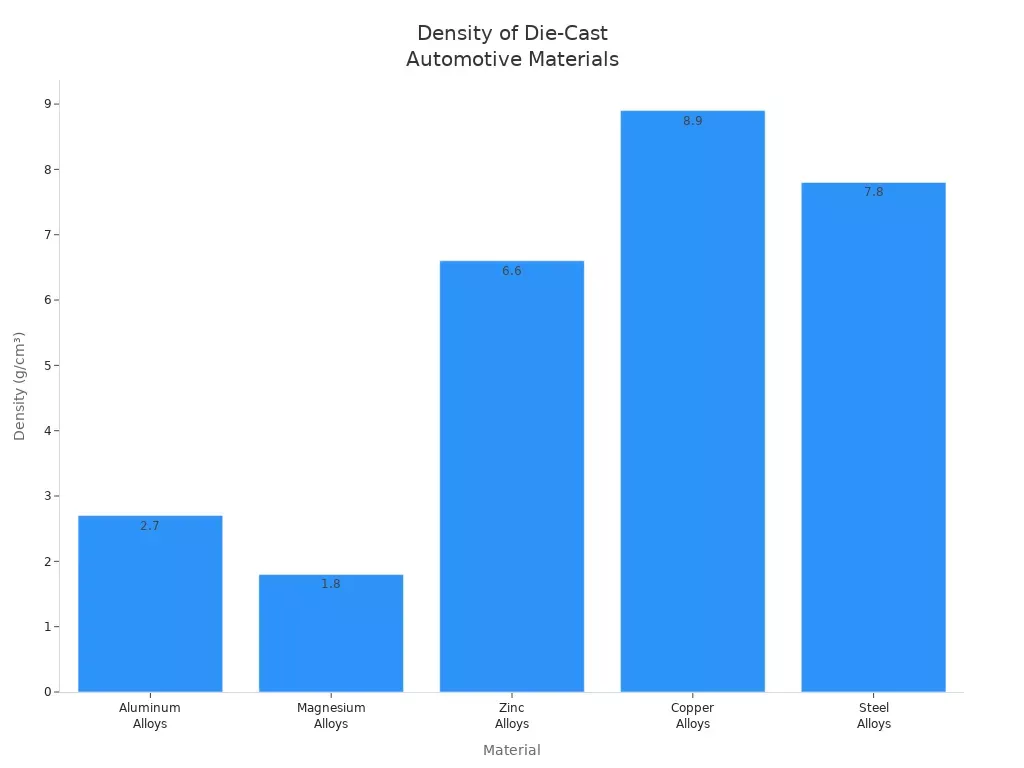
Automotive die casting shapes many important car parts. These parts are found in the engine, transmission, wheels, brakes, and chassis. The process uses metals like aluminum, magnesium, zinc, copper, and steel. Each metal has its own special use in cars. The table below shows which alloys are used, what they are good at, and where you find them in cars:
Material | Common Alloys | Key Properties / Values | Typical Applications |
|---|---|---|---|
Aluminum Alloys | A380, A383, A360 | Density: ~2.7 g/cm³, high strength-to-weight ratio, corrosion & heat resistance | Engine blocks, transmission housings, EV battery enclosures |
Magnesium Alloys | AZ91D, AM60, AM50 | Density: ~1.8 g/cm³, 33% lighter than aluminum, good damping capacity | Steering wheels, seat frames, interior supports |
Zinc Alloys | Zamak 3, Zamak 5 | Density: ~6.6 g/cm³, high strength, detail accuracy, low melting point | Door handles, brackets, locks, trim parts |
Copper Alloys | C18200, C95400 | Density: ~8.9 g/cm³, excellent conductivity, wear resistance | Electrical connectors, heat sinks, EV bus bars |
Steel Alloys | AISI 4140, AISI 4340 | Density: ~7.8 g/cm³, high tensile strength, rigidity, fatigue resistance | Safety brackets, drivetrain, reinforcement parts |
You need engine blocks and cylinder heads to start your car. Aluminum die casting makes these parts lighter and stronger than old iron ones. This process lets companies make lots of parts quickly, so prices stay low. The parts come out smooth and fit well, which helps your engine work better. Aluminum die casting also lets workers use self-tapping screws, so putting the engine together is faster and easier. This gives you an engine that is strong, light, and uses less fuel.
Note: Lighter engine blocks make your car weigh less. This helps your car use less gas and pollute less.
Transmission cases and housings keep the gears safe in your car. Automotive die casting makes these parts the right size and shape. This means your gears shift smoothly and the moving parts are held tightly. The parts are strong but not heavy, so your car does not waste energy. The table below explains why die casting is a good way to make these parts:
Benefit | Description |
|---|---|
Rigid Components | Strong and durable, resist wear and tear |
Lightweight | Lower weight improves energy efficiency |
Precise Dimensions | Accurate fit ensures smooth gear shifting and power delivery |
This helps your car handle better and makes the transmission last longer.
Wheels and brake parts must be strong and safe. Automotive die casting lets you use light metals, so your car is not too heavy. This saves gas and helps the car move easily. The process makes sure every part is made well, which is important for safety. You get wheels and brakes that last a long time and work well. Here are some main benefits:
Light wheels help your car move with less energy.
Strong die casting parts keep you safe while driving.
Less weight means your car handles better and uses less gas.
Die casting also makes it faster and cheaper to make lots of parts. You can make tricky shapes and use less material, which saves money.
The chassis is the main frame of your car. Automotive die casting makes chassis and other strong parts that are light but tough. These parts hold up the car and keep you safe in a crash. The process lets companies make lots of parts fast, so cars do not cost too much. You see die casting used for body frames, cross members, and other important supports.
Tip: Aluminum chassis parts are light and can do many jobs at once. Steel parts are very strong and protect you in a crash. Some cars use both to get the best mix.
As more cars are made, people will need even more die casting automotive parts. This process helps you get safer, better, and cheaper cars.
You want your car to use less gas and go farther. Automotive die casting helps make this happen. The process makes lighter parts instead of heavy steel. When your car uses lighter parts, it needs less energy to move. This saves you money on gas and helps the planet by lowering pollution.
Cars with die cast parts can weigh 23.5% less than steel cars.
Some new designs show a 51.1% drop in weight.
Lighter cars use less gas and make fewer greenhouse gases.
You get better speed and handling with less weight.
Automotive die casting helps the industry be more efficient and green. You see these good changes in both gas and electric cars. Lighter cars can drive farther on one charge or tank.
You want your car to last and keep you safe. Automotive die casting gives you strong and tough parts. The process uses metals like aluminum and magnesium. These metals help parts handle stress and shaking.
Manufacturing Method | Typical Strength Metrics | Durability Factors |
|---|---|---|
Die Casting | Better properties based on alloy | Fatigue life can reach millions of cycles |
Forging | Keeps high strength from raw material | Usually high durability |
Sand Casting | Changes a lot based on alloy | Environment matters a lot |
CNC Machining | Strength of raw material used | Can make very tough parts |
Die casting parts help your car pass hard tests for lasting power. These parts soak up shakes, so cracks and breaks are less likely. Cars with die cast parts have a 15-20% lower failure rate in long tests. You can count on these parts to keep you safe and your car running for years.
You want your car to work well. That means every part must fit just right. Automotive die casting lets you make parts with tight tolerances. The process can be as accurate as ±0.005 inches. This means your parts fit together without gaps or trouble.
Die casting makes shapes that other methods cannot do.
You get detailed designs with smooth surfaces.
Most die casting parts need little or no extra work.
The process saves time and money when making car parts.
When you use die casting, you get high-quality parts that boost safety and performance. Making complex shapes also helps with new car technology.
You want cars to be cheap and easy to get. Automotive die casting makes this possible. The process is fast and good for making lots of parts. You can make thousands or millions of parts from one die.
For a typical aluminum die casting transmission housing, the cost per part can be 60–80% less than machining.
The process allows for quick production, sometimes in seconds or minutes.
Reusable dies lower the cost for each part.
High pressure die casting helps mass production and automation.
Automotive die casting helps the industry meet demand and keep prices low. The process also helps the planet by cutting waste and energy use. You see these benefits in many die casting car parts, from engines to wheels.
Tip: When you pick die casting automotive parts, you get strength, accuracy, and savings. This helps the car industry build safer, better, and more efficient cars for everyone.
You want your car to work well and last long. Automotive die casting helps with both things. This process uses metals like aluminum and magnesium. These metals make parts strong but not heavy. Lighter parts help your car go faster and use less gas. The process also makes it easy to create detailed shapes. This helps engines run better. For example, aluminum die casting makes cylinder heads with tiny air and fuel paths. This makes the engine work better.
Here is how die casting for automotive industry helps your car:
Benefit | Description |
|---|---|
Lightweight Components | Die casting lets you use light metals, so cars weigh less. |
Improved Engine Efficiency | Small paths in cylinder heads help air and fuel move better. |
Reduced Emissions | Lighter cars use less gas and make less pollution. |
Quality is important for every part. Die casting parts must meet tough rules. The process uses checks like AI inspection and regular die care. These steps keep parts safe and strong.
You want to help the planet. Automotive die casting helps in many ways. The process uses metals like aluminum that you can recycle. Most die casting parts are used again after cars are done. This means less waste and fewer new materials. The process makes very little scrap, so you help the earth when you pick these parts.
Lighter cars from die casting parts use less gas and make less greenhouse gas.
The process uses metals you can recycle, which helps the planet.
Scrap metal from making parts is used again, so there is less waste.
You see new things in cars every year. Die casting for automotive industry leads many of these changes. Giga casting lets you make big parts in one piece. This helps electric cars. Smart die casting uses sensors and AI to check quality. Additive manufacturing, like 3D printing, helps you make new shapes. These shapes are strong and light. High pressure die casting makes parts faster and more exact.
Giga casting and electric cars are changing how die casting works.
Smart systems and new metals help you get safer and greener cars.
The industry uses high pressure die casting to make more parts and meet tough rules.
Tip: When you pick cars with new die casting parts, you help make cars better and cleaner.
You can see that automotive die casting makes important parts like engine blocks, transmission cases, and chassis. These parts are strong, light, and made to fit well. This helps your car work better. The process gives many benefits. It makes cars safer, saves energy, and keeps prices lower. As more electric cars are built, you will see more recycled materials and smart technology in new cars.
Aluminum die casting is special because you can recycle it many times. The molds can be used thousands of times.
Future Trend | What It Means for You |
|---|---|
More recycled materials | Greener cars and less waste |
Smarter manufacturing | Better quality and lower costs |
You see aluminum, magnesium, zinc, copper, and steel used in die casting. Each metal gives your car parts special strength, lightness, or durability.
Die casting lets you make strong, light, and precise parts fast. You save money and get parts that fit well. This helps your car perform better and last longer.
You can recycle most die cast parts. Aluminum and magnesium parts often get reused. This helps you protect the environment and reduce waste.
Die casting creates tough parts for your car’s frame and brakes.
Strong parts help protect you in crashes.
Accurate shapes make sure safety systems work right.


